MVP Development Company: How to Go From Idea to Launch and Beyond

HelloDevs
Oct 15, 2026
If you are looking for an MVP development company, you probably have an idea you believe in and a worry that building it will cost more, take longer and sprawl further than you can afford. Both are reasonable. A good MVP development company should shrink the idea before it builds anything.
An MVP is the smallest version of a product that is worth putting in front of real people. 'Smallest' is not 'cheapest' and it is not 'rough'. It means the least you can build to learn whether the idea works, built well enough that what you learn is true.
What a good MVP development company does
MVP development is mostly decisions, with code coming second. Which problem are we solving? For whom? What can wait? The build itself is quicker and less risky when those answers exist.
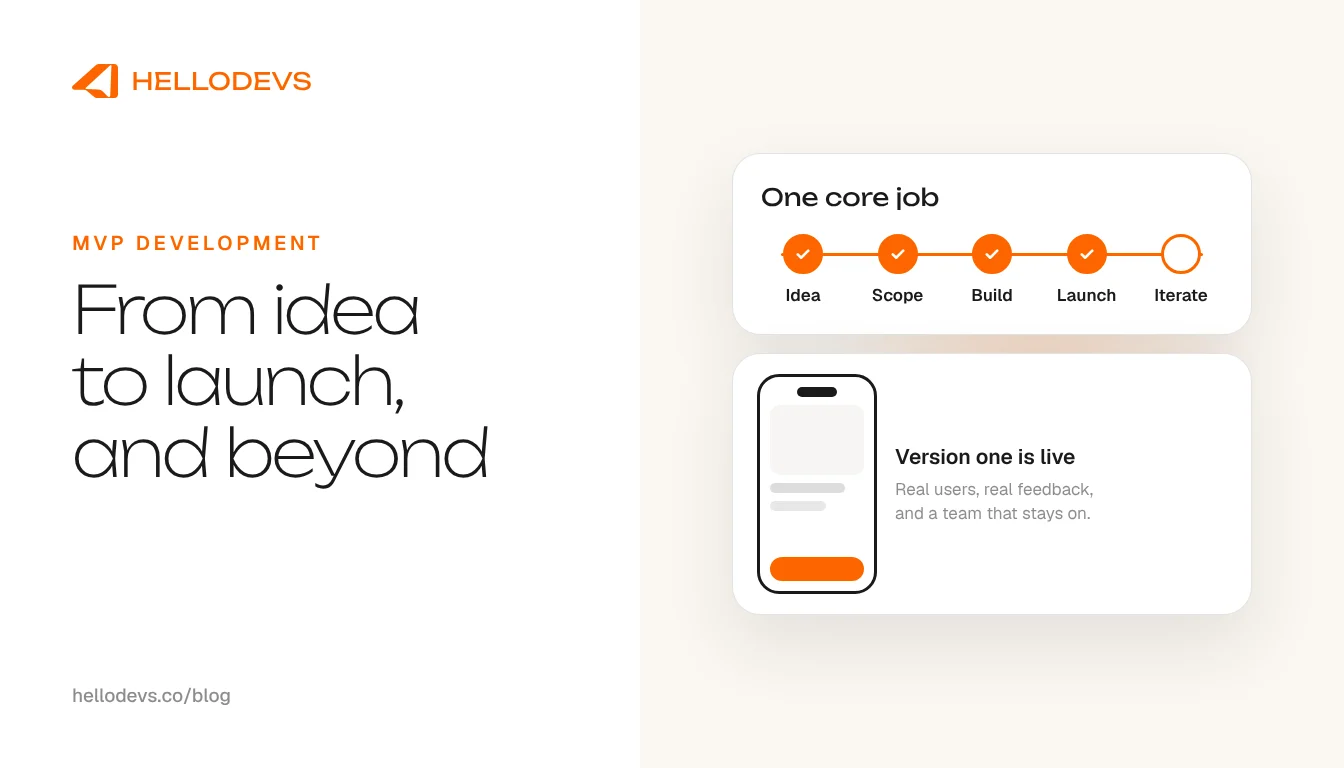
At HelloDevs the process is simple to describe. You bring a concept. We help you shape the smallest version worth launching, build it, launch it, and stay involved afterwards as a long-term product and engineering partner, iterating on what real users actually do. That last part matters most, and it is where many projects fall short.
A useful test when you speak to any MVP developer is whether they start by asking about the build or about the user. The best conversations begin with who is struggling, what they do today and why the current options are not good enough. Technology choices come after that, and they are usually less dramatic than people expect.
How to scope an MVP
Scoping is where an MVP is won or lost. These five questions do most of the work.
Pick one core job
Describe the single thing your product helps someone do. If you need two sentences and an 'and', you probably have two products. Start with the job people would pay, switch or change habits for.
Name who it is for
Write down one specific kind of user, not 'everyone'. A narrow first audience gives you clearer feedback and a clearer reason to build each feature.
Decide what to leave out
This is the hard bit. List every feature you imagine, then mark what the core job truly cannot work without. Admin dashboards, rich settings, extra integrations and polish for rare cases can usually wait.
Decide what you will measure
Agree before launch what would tell you it is working. It might be people finishing the core task, returning, or asking for the next feature. Without that, launch produces opinions instead of evidence.
Choose the smallest build that tests it
Sometimes that is a web app. Sometimes a mobile app. Sometimes a lightweight version that handles part of the process by hand while you learn. Pick the cheapest honest test.
If your idea is a connected storefront or a growing catalogue, our piece on building a mobile app for a Shopify store walks through the same kind of scoping.
Web, mobile or both?
The right first platform depends on how people will use the product, and it is worth deciding on purpose rather than by habit. Something used at a desk, with accounts and dashboards, often starts as a web product. Something used on the move, with the camera, notifications or location, often earns a mobile app early. Plenty of products launch on one and add the other once usage tells you where people are.
We build both. See how we approach SaaS product development for web-based products and mobile app development for iOS and Android.
What a good partner does after launch
Launch is where the evidence starts. A good app development partner stays involved afterwards, and by 'partner' we mean a working relationship: we remain engaged with your product after it goes live. We are not describing a legal or financial arrangement.
In practice that means watching how people use the product, and fixing what breaks. It also means helping you decide what to build next, based on behaviour rather than assumptions. It means keeping the product secure and the foundations sound as it grows, so the next feature does not make the last one fragile. And it means being straight with you about when to stop building something nobody uses.
This is what separates startup app development that lasts from a one-off build. The first version is a hypothesis. The partner is whoever helps you learn from it.
Practically, the first weeks after launch tend to be about small things that matter a lot: a confusing sign-up step, a screen nobody finds, a slow query that only shows up with real data. These are cheap to fix when someone is still close to the code and expensive when the team that built it has moved on. That continuity is the reason to choose a partner who plans to stay.
Red flags when choosing an MVP development company
You can learn a lot from how a company talks about your idea before you sign anything.
They say yes to everything
A team that never pushes back on scope is not protecting your budget. A good partner will tell you which features to cut.
They promise guaranteed results
Nobody can guarantee users, revenue or investment. Be wary of anyone who does.
A fixed price before they understand the problem
A quote with no discovery behind it is a guess. Ask how they scope, and what happens when scope changes.
Nothing about life after launch
If the conversation ends at delivery, you will be on your own at the point you most need help. Ask who fixes things, who iterates, and how.
You do not own the code or accounts
The repository, hosting, domain and data should belong to you. Ask this on the first call.
No questions about your users
If they never ask who the product is for, they are building to a feature list rather than to a purpose.
Only slides, no working software
Ask to see something real they have shipped, and to talk about what went wrong as well as what went well.
Questions to ask before you choose
Bring a short list to your first call. Who will actually work on the product, and will they be the people you speak to now? How do you decide what goes into the first version? What do you need from me each week? What happens if the first version teaches us something that changes the plan? Who owns the code, the accounts and the data at the end?
The answers matter less than the way they are given. A team that explains its reasoning, admits what it does not know and describes how it handles change is much easier to work with than one that sounds certain about everything.
One message away
You do not need a spec, a pitch deck or a finished plan to start a conversation. Tell us the idea as you would tell a friend. A short message works, and so does a voice note on WhatsApp. We are one message, one voice note, one prompt away.
Share your concept through the contact form and we will help you work out the smallest version worth building.
HelloDevs
Shopify development
Practical guides to planning, building and maintaining Shopify projects. Explore the linked product case studies for examples of our work.



Stay Updated
Get raw, honest dev-first tutorials and tech blog articles delivered straight to your inbox once a week.
Start a Shopify project
Let's Connect!
Tell us your requirements and get a professional developer response.