

Faqly AI FAQ Builder for Shopify
Faqly drafts FAQ answers from your own product data, hands them to you to edit and arrange, and publishes them with valid structured data — with the AI treated as an untrusted source on the way in and on the way out.
- Built by HelloDevs
- Two access scopes
- Submitting to the App Store soon
FAQ content is the work merchants mean to do and never finish. Faqly removes the blank page — and was built on the assumption that anything a model returns might be wrong, malformed or hostile.
Faqly, built by HelloDevs
A HelloDevs app in the final stage before App Store submission. Everything below is implemented in the code; nothing on this page describes a feature we plan to add.
Why store FAQ pages stay thin
Four reasons FAQ pages go unwritten or go wrong
Merchants know which questions they are asked every day. Turning that into good, current answers is the part that does not happen.
- The blank pageThirty good answers in the brand's voice is a day nobody has, so the page stays thin and the same questions keep arriving in support.
- Content that decaysAn FAQ written at launch describes a catalogue and a returns policy that have both changed since. Nobody owns keeping it current.
- Markup that drifts or never existsStructured data tells crawlers and AI answer engines exactly which questions a page answers. Most FAQ apps emit none, and hand-written markup drifts from the page the first time someone edits an answer.
- A new risk surfaceAn app that puts merchant text into a model and renders the result into a storefront has created an injection path — into the prompt on the way in, and into the page on the way out.
What Faqly does
From blank page to published FAQ
Everything a merchant needs to write, arrange and publish an FAQ, without touching code.
- AI-drafted answersAnswers drafted with GPT-4.1 from the merchant's own product data and context — as drafts to edit, never published raw.
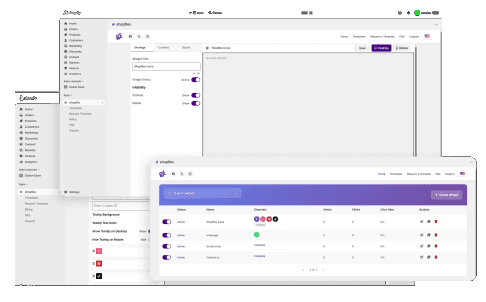
- A visual block builderQuestions, headings, dividers, buttons, images with alt text, video, alerts, quotes and categories — a page builder scoped to FAQ content.
- FAQPage structured dataValid FAQPage JSON-LD generated from the published content, so the markup always matches the page. Google stopped showing FAQ rich results in 2026, but other search engines and AI assistants still read the markup.
- TemplatesA template library to start from, with AI-assisted styling that can only choose from whitelisted, range-checked settings.
- Per-FAQ analyticsLoads, views and clicks for each FAQ, so a merchant can see which answers are read.
- AI usage meteringGeneration logged per shop, by model and date, so AI cost is visible rather than a surprise.
How Faqly is built
The decisions behind it
The engineering worth reading is on the AI boundary: the model is treated as an untrusted source on both sides.
- Merchant input is screened before the model sees itMerchant-written context reaches a model that also holds system instructions, so input is checked against an explicit set of prompt-injection patterns before the call.
- Structured outputs, not parsed proseThe model is called with a response schema and returns a typed object. Parsing free text with patterns is where AI features become flaky at exactly the moment a merchant is watching.
- Output is validated and escapedEvery answer is validated against its schema and HTML-escaped before it is stored, so nothing a model returns can render as markup in a customer's browser.
- Settings from a whitelist, not a passthroughWhen the model suggests styling, unknown settings are dropped, numbers are clamped to safe ranges and unknown options fall back to a safe default. A model that returns a font size of 9,000 gets the default, not the storefront.
- Stored content that outlives its formatEvery FAQ document carries a schema version, so content saved in an older shape stays readable after the format changes — no emergency migration, no silently broken pages.
The Shopify surfaces Faqly uses
Built on Shopify's current app stack
Built on Shopify's React Router app template, with two access scopes.
- Theme app extensionHow published FAQs reach the storefront, placed in the theme editor with no theme code edited.
- GraphQL Admin APIProduct data read to ground the drafts, with read_products and write_products as the only scopes.
- MetafieldsPart of how published FAQ content is stored and delivered alongside the theme app extension.
- OpenAI structured outputsGPT-4.1 with response schemas and bounded token limits, behind the input and output checks above.
What Faqly has achieved so far
What we can say — and what we can't
Faqly has not been submitted to the App Store yet, so there are no install or merchant figures, and none are claimed. This is what the code itself shows.
- Sanitisation on both sides of the modelInput screened for injection; output validated, escaped and whitelisted.
- Markup generated from the contentFAQPage structured data produced from published content, so the two cannot drift apart.
- Two access scopesProducts only — no customer or order data.
Faqly was built by the same team that does our AI integration and Shopify app development work for clients.
Start a Shopify project
Let's Connect!
Tell us your requirements and get a professional developer response.