
AiSalesQ Product Quiz & Attribution
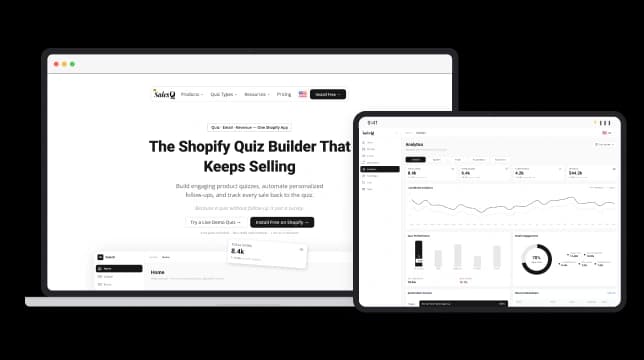
A Shopify quiz app that owns the whole chain — the recommendation, the email sequence, the discount and the attribution that proves it worked — so a merchant can answer the one question a stitched-together stack cannot: which quiz answer produced revenue?
- Built by HelloDevs
- Attribution through orders/paid
- Submitting to the App Store soon
Most quiz apps ask questions, show a product and hand an email address to someone else's tool. AiSalesQ keeps the recommendation, the follow-up, the incentive and the order in one data model — so it knows when a quiz earned a sale, and when to stop emailing.
AiSalesQ, built by HelloDevs
A HelloDevs app in the final stage before App Store submission. Everything below is implemented in the code; nothing on this page describes a feature we plan to add.
Why most product quizzes cannot prove they work
Where a typical quiz stack breaks
The quiz is rarely the problem. Everything commercially interesting happens after it — in tools that do not know the quiz exists.
- Attribution is missingA quiz plus an email platform can report opens, clicks and list growth. None of those are revenue, and asked which quiz — or which answer — produced sales, the honest answer is a guess.
- Incentives are manualOffering a discount with a quiz result usually means creating codes by hand and pasting one into an email. It does not scale, and nothing stops the same shopper resubmitting for a fresh code.
- Sequences do not know when to stopA follow-up sequence in a disconnected tool keeps sending after the shopper has bought, because the order never reaches it.
What AiSalesQ does
From the first question to the paid order
One application, so every step knows about the others.
- Visual quiz builderA document-model editor with registered element types, rich text, colour controls and custom CSS — extended by adding elements, not by special-casing questions.
- Automation builderA node-graph email sequence editor with enrolment rules, scheduling, run tracking and funnel counts.
- Rule-based recommendationsResults are chosen by rules the merchant sets, not by a model. For a bounded quiz that is usually the better answer: predictable, explainable and free to run.
- Automatic discountsCodes issued per quiz result, with a written anti-abuse policy: a code is only reissued if the last one went unused.
- Revenue attributionEach paid order is matched back to the subscriber and the quiz answers that produced it.
- Abandoned-cart trackingCarts started from a recommendation are tracked, and closed when the order is paid.
- Consent kept in syncMarketing consent follows Shopify's own customer record, including when the customer changes it outside the quiz.
- Three ways onto the storefrontAn inline quiz, a button and a full section, all as theme app extension blocks.
How AiSalesQ is built
The decisions behind it
The interesting engineering is not the quiz. It is making one order event do five jobs correctly.
- Quiz definitions live in ShopifyQuiz structure is merchant content, so it is stored in metaobjects — queryable from the storefront and still there if the app is removed. Submissions, subscribers and automation runs are high-volume operational data and live in the app's own database.
- One webhook, five consequencesWhen orders/paid arrives, the same handler attributes the revenue to the quiz answers, closes the abandoned cart, marks the discount redeemed and stops the follow-up sequence — so nobody is chased to buy what they just bought.
- Attribution that does not depend on a discount codeOrders are matched to subscribers by email across the four fields Shopify may populate, rather than by whether a code was applied — which fails every time a shopper checks out without one.
- Enrolment that cannot double upThe automation engine refuses to enrol the same person twice, or someone who should not be in a sequence at all — the classic failure of email automation.
- Consent as a first-class eventThe app subscribes to customers/marketing-consent alongside customer create, update and delete, so a quiz that captures emails never loses track of whether it may send to them.
The Shopify surfaces AiSalesQ uses
Built on Shopify's current app stack
Built on Shopify's React Router app template, against the GraphQL Admin API.
- MetaobjectsQuiz definitions stored as structured Shopify content, with their definitions created by the app.
- WebhooksThirteen topics subscribed and handled, including orders/paid and customers/marketing-consent.
- Discounts APICodes created programmatically per result, with quiz-scoped entitlement.
- Theme app extensionsThe inline quiz, the button and the section, placed by the merchant in the theme editor.
- Billing APIPlan metering with capped-amount handling, on the merchant's Shopify invoice.
What AiSalesQ has achieved so far
What we can say — and what we can't
AiSalesQ has not been submitted to the App Store yet, so there are no install, retention or merchant revenue figures, and none are claimed. This is what the code itself shows.
- Attribution implemented end to endFrom quiz answer to paid order, through the orders/paid webhook.
- A discount policy written before the codeSpecified in its own document, built to it, and defaulted so existing quizzes do not change behaviour.
- Thirteen webhook topics handledIncluding consent, which most quiz apps do not track at all.
AiSalesQ was built by the same team that does our Shopify app development and Shopify development work for clients.
Start a Shopify project
Let's Connect!
Tell us your requirements and get a professional developer response.